

Skip to content
Smelcom Robotics
Software

The brains of the system

A vehicle is a hull, thrusters and a camera. Everything that separates eight hours of useless video from a ready list of defects lives in the software. We write it ourselves.

Interface

Live view from the vehicle

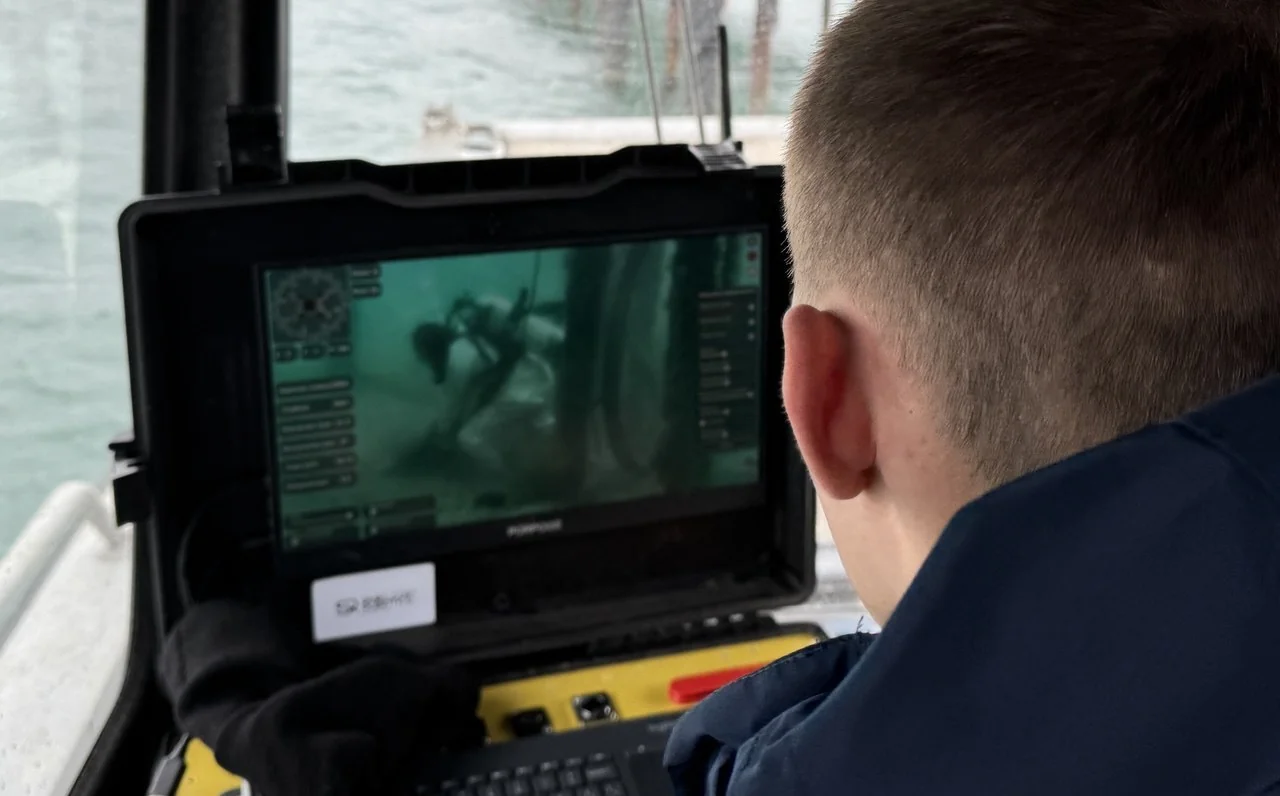
The operator sees the underwater scene, telemetry and image-processing results on a single screen.

Control station screen: underwater inspection of a support pile
Inspecting a berth support: the vehicle's view on the operator's screen
Screens from real jobs

What the operator sees

Frames from a hydraulic-structure survey: telemetry, heading and roll sit on top of the live view, the panels can be rearranged to suit the task and left-handed pilots, and image processing pulls detail out of turbid water. The vehicle backs up the diver and records his work for the report.

Machine-vision navigation

Problem
Acoustic positioning means extra hardware, an antenna and time. In tight spots by a wall or between piles it works poorly because of reflections.

Solution
PROMETEY derives its position relative to the object from the image: it holds distance, tracks along a structure, returns to a marked point - with no external navigation.

Limit
At zero visibility machine vision does not work - for such conditions there is the sonar.

Defect video analytics

Problem
A berth-survey shift is six to eight hours of video. The engineer watches it twice. The report comes out a week later.

Solution
Defects are recognized as they are filmed and marked on the recording with a time code and telemetry. You get a list of findings, not eight hours of video.

Limit
Video analytics does not replace the specialist and does not sign the report. It finds and shows - the conclusion stays with the engineer.

Smart stabilization

Problem
Current at the wall, reflected flow, tether tension. An inexperienced operator fights the vehicle instead of surveying, and the image drifts.

Solution
Automatic hold of depth, heading and distance. A steady image means photogrammetry comes together. The entry barrier for the operator is lower.

Limit
Image-based hold works reliably up to roughly 2 knots of current; in strong drift or total darkness the holding accuracy drops.

Condition monitoring

Problem
A thruster failing at depth 40 km from base is not just 'broken' - it is a lost vehicle and a blown contract.

Solution
The system continuously monitors components and warns the operator of a deviation before failure. Runtime data lands in the account portal for spare-parts planning.

Limit
The system warns and helps bring the vehicle up, but does not replace scheduled maintenance and spare-parts inspection.

Rights

The software is developed in-house by Smelcom Robotics LLC. Registered with Rospatent through certificates of state registration of computer programs; key algorithms are protected as trade secrets (know-how).